Korean
Culture School
케이컬한국문화학교

2027 Spring Semester: Feb. 6 ~ May 8
NO class: 3/25 - 3/27 (Easter week)
Register: Oct. 01, 2026~ Feb. 10, 2027
2027 Summer *Online Only: June 3~Aug 5
Beginner & Intermediate
Register: Jan. 1~ May 15
2027 Fall Semester: Sept. 4 ~ Dec. 4
NO class: 11/25 - 11/27 (Thanksgiving)
Register: March 1~ Aug. 31
NEWS & EVENTS
Teens Investigate Viral “Pikachu at Protest”
Video at Youth AI Forum
High school students learn to distinguish fact from fiction through hands-on
media literacy investigations at Temple University
As artificial intelligence (AI) technology advances rapidly, concerns about
misinformation and the misuse of digital content continue to grow. Against this
backdrop, a group of high school students gathered at Temple University to
develop critical thinking and media literacy skills through hands-on investigations.
The Korean Cultural Foundation (KCul), led by Executive Director Insook Seol,
hosted the 2026 Youth AI Forum: “What Should We Believe?” on October 10
at Temple University, bringing together high school students from the Greater
Philadelphia area.
Organized in collaboration with Temple University's Center for Media and
Information Literacy, the forum was designed to help students identify
AI-generated or manipulated media and develop the skills to independently
question and evaluate the credibility of digital information.
Rather than simply listening to lectures, students became “media investigators,”
working in teams to complete a series of investigative challenges. They learned
a six-step verification framework that examined sources, evidence, context, authenticity, and the purpose behind digital content. Students then applied the framework to AI-generated videos and social media posts to assess their credibility.
Before the hands-on sessions, Paul In Yoo, co-founder and CEO of the AI biotechnology startup Plasmal, delivered a presentation titled “Beyond the AI Hype: Skills That Will Matter in Your Future.” He discussed examples of AI-generated errors appearing even in academic research papers.
Paul In Yoo encouraged students to develop the ability to evaluate AI-generated information while strengthening their creativity, critical thinking, and individual areas of expertise.
Temple University professor Sherri Hope Culver also delivered a presentation titled “Truth, Trust, and Critical Thinking in the Age of AI,” emphasizing the importance of critically evaluating media information in an increasingly AI-driven world.
Investigating a Viral Pikachu Protest Video
One of the most engaging cases involved a viral video showing the popular Pokémon character Pikachu appearing at a protest in Istanbul, Turkey.
Instead of assuming that the entire video was authentic simply because a real protest had occurred, students carefully examined visual clues. They identified inconsistencies in police uniforms and lettering on vehicles, Pikachu's movements and positioning, and discrepancies involving backgrounds and reflections.
Students then cross-checked external sources and supporting evidence to investigate whether AI-generated elements had been added to footage of an actual protest.
The students also analyzed the mansion featured in the Academy Award-winning Korean film Parasite, along with videos of bridge collapses circulating online.
Through these investigations, they discovered that elaborate physical movie sets and visual effects can sometimes resemble AI-generated imagery, while dramatic and seemingly realistic videos may themselves be created using AI.
The exercises encouraged students to move beyond asking whether something “looks real” and instead focus on a more important question: “What evidence supports it?”
A Surprising Discovery About Parasite
Professor Sherri Hope Culver, who observed the students' presentations, expressed surprise at one of their findings.
“I really love the Korean film Parasite, but I had never thought that the house in the movie might not be a real house. That's amazing,” Culver said.
Students explained that the mansion had been constructed as a film set, enhanced with visual effects, and dismantled after filming. Their findings sparked an engaging discussion with the professor.
Throughout the forum, students practiced resisting the temptation to immediately label unfamiliar videos or social media posts as either “real” or “fake.”
Instead, they discussed what evidence was needed, collaborated with teammates, and searched for additional information before reaching conclusions.
Preparing the Next Generation of Digital Citizens
KCul and Temple University's Center for Media and Information Literacy explained that the forum was intended to go beyond teaching students how to use AI tools.
“We wanted students to experience how to ask the right
questions amid the overwhelming amount of digital
information and how to evaluate credibility and possible
manipulation based on evidence,” the organizers said.
Insook Seol, Executive Director of KCul, expressed
hope that the experience would have a lasting impact.
“I hope this forum will help young people, the leaders
of the next generation, grow into responsible digital
citizens,” Seol said.
Minjae Kim, a high school student who participated in the forum, reflected on what he had learned.
“I was surprised to discover how easily videos we see on social media can be manipulated using AI,” Kim said. “I'm glad I learned the six-step verification framework, which I can now use to evaluate the credibility of digital information.”
(By Jiwoo Jung, Student Intern Editor-in-Chief, The Next Korea)
UPCOMING EVENTS

Spring 2027 Korean Language Classes – Registration Now Open!
First Day of Classes: February 6, 2027
Montgomery County Community College
Celebration of Korean Seollal
(Lunar New Year)
Experience Korean Culture!!
February 1st, Saturday 2025
Montgomery County Community College
Korean Culture Camp
August 16th (Mon.) ~ 21st (Fri) 2027
Montgomery County Community College
2024 Korean Culture and History Summer Camp a Huge Success
KCul Korean School successfully concluded its week-long Korean Culture and History Summer Camp from August 19th to August 23rd. It was another incredible experience for everyone involved!
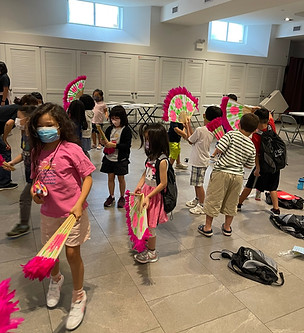
The camp began each day at 9 am with the reading of Korean folk tales. Each morning of the camp, students participated in cultural activities such as traditional Korean drum, dance, Taekwondo, and K-pop dance. In the afternoons, workshops were held where students could learn about culture and history by engaging in activities like making a Cheomseongdae of Silla, drawing traditional folk paintings, creating Goguryeo mural puzzles, painting the ten symbols of longevity on canvas, candle making, Korean calligraphy, and fan making. These activities provided a fun and educational way for children to immerse themselves in Korean culture and history.
The highlight of the camp was the exploratory game "Find the Lost National Treasure No. 1, Namdaemun (South Gate)!" which captivated the students' hearts. In this game, participants became detectives, solving secret codes and puzzles to find clues leading to the final destination. Students enthusiastically explored classrooms, lobbies, mini-stores, and outdoor spaces, showcasing teamwork through songs and dances, and competing to find clues first. Through this engaging activity, students learned about Korean culture, historical background, and the Taegeukgi (Korean flag) in a fun and interactive way.
It was an exciting week filled with unique and fun traditional Korean folk games such as Jegichagi, Jachigi, Ttakjichigi, and Yutnori. All the games were intense and exciting, and very LOUD!
We’d like to thank all of our camp families for spending the summer with us here at the MC3. We hope you have a wonderful school year and look forward to seeing you back at camp next year.
Finally, we’d like to thank our top-notch Korean Culture and History summer camp team for their endless energy, compassion, and creativity. Your hard work and tireless dedication helped to ensure that each of our campers had a summer full of fun and adventures.We are so proud to provide a memorable camp experience for each and every one of our amazing summer day campers. Summer day camp would not be possible without the dedication, versatility, and inspiring leadership of our Summer Camp staff team.




Korean New Year Celebration
February 13, 2021
Tteokguk (New Year Korean special rice cake soup) Party, yutnori(Korean traditional folk game), sebae (New Year's Bow) and more.


Experience Korean Culture Day: One day Korean school
October 03, 2020
Virtual Experience Korean Culture Day
-Cooking Gimbob, Korean Calligraphy, and more.

Explore Korean Culture : Summer camp
July 24, 2019
Summer Camp: explore Korean Culture
Programs: Korean dance (fan dance), cooking (kimbab) palm art (painted Taegeukgi)

One Day Pop-Up Korean School
April 21, 2018
Calligraphy class: Write my name in Korean.

One Day Pop-Up Korean School
April 22, 2017
Try on Hanbok

One Day Pop Up Korean School
April 16, 2016
KCul Academy Korean School opened one day Korean school. It opened to the public and they learned how to play Korean traditional instrument such as Jang-gu and Korean language.

Kpop Festival
October 25, 2015
Kcul Academy Korean School opened a KPOP festival for the students who love to learn about KPOP performances. They've learned not only how to dance like professional KPOP idols but also socialize and share cultural varieties.

Closing Ceremony of the School Year
May 21, 2015
Kcul Academy Korean School celebrated the closing school year 2014-2015 at Arisu Korean restarant in Blue Bell.

Korean Poetry Reading Competition successfully opened
May 21, 2015
The Korean Poetry Reading is a competition, designed to help all students of Korean School, Korean American 2nd generation, foreign students to share a beauty of Korean literature and to learn better Korean words and think carefully about the ingredients of a successful performance reading.


◄
1 / 1
►


Paul In Yoo, co-founder and CEO of the AI biotechnology startup Plasmal
Sherri Hope Culver ,
Temple University professor


